Monday, October 30, 2017

Osborne Lyon (1902-1931): Oakland Police Officer killed by truck

Oakland Police Officer Osborne Lyon (photo of gravestone by Michael Colbruno)
LOT 43

Oakland Police Officer Osborne Lyon was a motorcycle patrolman who was killed in the line of duty. He had been transferred to the Traffic Bureau shortly before his death.

In the early Sunday morning hours of August 19, 1931, Lyon was patrolling the streets of East Oakland when he observed a vehicle driving at a high rate of speed.  While giving chase, he sideswiped a truck and was thrown to the street, suffering a fractured skull and other injuries. He later died at Highland Hospital.
 
He was survived by his wife Vivian (née Chick) and son William.

Sunday, October 29, 2017

Richard Richardson (1831-1867): First Oakland Police Officer killed in line of duty

OPD Officer Richard Richardson and Headstone (photo: Michael Colbruno)
On October 23rd, 1867 Oakland Police Officer Richard Batten Richardson became the first member of the force to die in the line of duty. 150 years later his unmarked grave received a headstone due to the efforts of the Alameda County Heroes Grave Project. The project was organized by a group of Alameda County peace officers who are raising money to honor and place headstones at the unmarked graves of any peace officer killed in the line of duty in Alameda County. Richardson's grave kicked off the effort.

Richardson was killed when he went to execute a warrant to John Thomas at a shanty bounded by 9th St, 10th St, Brush and Castro streets in Oakland. Arriving on horseback, he encountered an elderly, nearly blind man who was being evicted from the property, which had been sold. Richardson did not know that the seemingly harmless looking man had murdered two men in El Dorado County and was believed to have a killed a man in Mission Dolores across the San Francisco Bay.

When the elderly man's wife refused to allow Officer Richardson entry, he forced his way into the house, and was shot in the neck by Thomas. The bullet severed his artery and hit his spinal cord. Thomas died in jail before being convicted of the crime.

Richardson was survived by his wife Mariah and sons Louis and Filaseo.

To learn more about the Alameda County Heroes Grave Project visit their website at ACHGP.org

Sources: San Francisco Call, Alameda County Heroes Grave Project, Ancestry.com

Friday, September 22, 2017

Edward K. Taylor (1860-1930): Alameda's first mayor; Banned spitting on the sidewalk

Edward "E.K." Taylor and the family plot
Plot 33, Lot 4

Edward "E.K." Taylor was born in Elmira on August 2, 1860. His father was the famous Bishop William Taylor, who organized the Methodist Episcopal Church in California. [Read his bio HERE]

Taylor grew up in Alameda where he attended the local schools before being admitted to the University of the Pacific. In 1885, he received his law degree from Hastings School of Law and was admitted to the California Bar on his birthday that same year.

In 1903, he was elected to the California State Senate where he served for four years. His major accomplishment was successfully promoting a constitutional  amendment which saved taxpayers about two percent interest on bonds. He also introduced legislation to protect both game and non-game live birds.

Taylor served as the City Attorney of Alameda from 1893-1907, where he worked to widen and pave streets, as well as beautify the city, acquiring Alameda Park along the way. He also successfully had Webster Street widened by over 30 feet. In 1907, he was elected to serve as mayor, where he successfully passed the first law in the country banning spitting on the sidewalks. Devoted to the welfare of children, he enlisted the help of Alameda's youngest citizens to promote the construction playgrounds on the island community.

Upon his death in 1930, the city of Alameda had his body lie in state at City Hall for four days before his burial in the Taylor family plot at Mountain View Cemetery.

Monday, September 4, 2017

James Latham (1830-1876): Stock Broker; Early Animal Rights Advocate

James Latham monument (photos: OaklandWiki)
James Hoge Latham (1830-1876) was born in Columbus, Ohio, served in the US-Mexican war at age 17, and worked for Wells Fargo & Co. in Victoria and Sacramento. He later opened what was then the largest brokerage business in San Francisco.  One of his brothers, Milton S. Latham, was the 6th governor of California, a Congressman and a United States Senator. 

His wife Henrietta had family roots in the California Gold Rush. 

Along with his wife, he was an early advocate for animal welfare, donating large sums of money to the cause of animal rights. Henrietta was a staunch advocate for the humane education of children from an early age. The family claimed that when James visited a new city, he often visited the zoological gardens first to check on his animal friends.
 
Latham Fountain (photo: City of Oakland; drawing: Oakland Tribune)

The Latham Fountain was erected in their memory James and Henrietta's memory by their three children, Edith, Milton and Charles. The fountain at the intersection of Telegraph & Broadway in downtown Oakland, was built to honor the Latham's work in "animal respect activism" and for the promotion of humane education, whose purpose was to teach the respect of animals and others in schools. A foundation was created, which originally stood at the Latham Square Building overlooking the fountain. The Latham Foundation continues today at www.latham.org.

Before the unveiling there had been only one memorial to local citizens in downtown Oakland, the Jack London memorial oak tree in Frank Ogawa Plaza.

In 1876, James Latham had been ill so, his doctors recommended a sea voyage for his health. Just three days out from New York, James died at sea aboard the steamship Celtic. Henrietta returned to Oakland with his body, and James was buried in Mountain View Cemetery, in the Latham family grave in plot 9. The funeral was held at St. Paul's Church on 12th Street near the Grand Central Hotel. The music for the program was lead by Oakland Municipal Band director Paul Steindorff, who is buried right down the road from the Lathams. 

The Latham monument was designed by the noted firm of Seregni & Bernieri, who also designed the nearby monument of A.K.P. Harmon, as well as those for David Colton, Frederick Delger and the iconic angels sitting atop the graves of Henry Crocker and Frances Scmidt. The angel at the top of the Latham monument glances downward awaiting the arrival of the departed.

Henrietta Latham, who also wrote one of the first vegetarian cookbooks, published in 1898, called The Golden Age CookBook, lived until 1909.

The 15' x 12' fountain was designed by the distinguished French sculptor Monsieur Payre, and was originally envisioned to be built on a smaller scale. The memorial originally contained drinking fountains alongside water troughs so that both man and beast could enjoy refreshment. After Payre’s model was sent to the US, the Gorham Company of New York fabricated the piece using expensive pink Maine granite and American standard bronze. 

In August 2017, noted vegan author and activist Colleen Patrick-Goudreau led a walking tour to the fountain to honor the legacy of these early animal rights pioneers.

Sources: OaklandWiki, Latham.org, Oakland Tribune, City of Oakland

Saturday, May 13, 2017

Walter Balfour Harrub (1830-1912): Successful Gold Miner; Entrepreneur


Grave of Walter and Katherine Harrub (photo by Michael Colbruno)
PLOT 12

Walter Balfour Harrub was born in Plymouth County, Massachusetts on July 16 1830. He lost his mother as a young boy and was basically on his own from that point. He learned the trade of a shoemaker while living with an uncle, but eventually became a cooper, a person who makes or repairs casks and barrels.

At age 19, he came to California during the Gold Rush aboard the barque* Pleiades. He arrived in San Francisco on September 18, 1849 after a 218 day journey and set out for Marysville, which was known as the "Gateway to The Gold Fields." During a trip back to San Francisco, Harrub fell and ill and required six months to fully recover. He eventually settled in Foster Bar, California and hired some Native Americans to take him to a nearby location where he staked ten claims and was successful in finding gold.

Ruby Hill, California during the Gold Rush days
He took his earnings and opened a hotel near Fremont and managed the food operations at a hotel in Shasta, but eventually returned to the gold fields near Grass Valley. He took his money and invested in a variety of ventures. He opened a large cattle ranch near Sacramento and a butchering operation in Dayton (formerly Grainland), located in Butte County, California. He also operated a freight line from Dayton to both Virginia City and Washoe City, which also carried mail. Perhaps his largest venture was forming the Ruby Hills Water Works, named after the nearby mining camp.  Harrub built two pipe lines covering 10 miles, which supplied water to most of the neighboring mining camps.

In 1874, Harrub moved his family to Oakland, where he bought four homes and other property in the Fruitvale area. His second wife Katherine was a well-known hostess of society events in Oakland.

He died after suffering from an abscess of the throat for six months.

* Barque: a sailing ship, typically with three masts, in which the foremast and mainmast are square-rigged and the mizzenmast is rigged fore-and-aft.

SOURCES: History of the State of California by James Miller Guinn, Wikipedia, The San Francisco call, Ancestry.com, Oakland Tribune

Monday, May 8, 2017

Dr. Richard Hersey (1949-1990): Lobbied for affordable AIDS drugs; Partner of neuroscientist Simon LeVay

Richare Hersey
Plot: 50 
GPS (lat/lon): 37.8339, -122.23381

Richard George Hersey was born in Berkeley on October 9, 1949 in Berkeley, California and graduated from Miramonte High School in Orinda in 1967.

He was an American exchange student in England when he met Simon LeVay, who would go on to become one of the leading researchers about the human brain in the world.

In 1971, while Hersey was completing his studies at the University of California at Berkeley,  LeVay got a job with future Nobel Prize winners David Hubel and Torsten Wiesel at the Harvard Medical School. The couple bought an old Volkswagen Bug and traveled across the country to meet Hersey's parents. In 1972, Hersey went east with LeVay and did some course work at Boston University. He eventually was accepted in the UCLA School of Medicine, so the couple lived on opposite coasts. After medical school, he did his internship at Boston City Hospital and the couple were reunited, living in the Beacon Hill area.

After graduation, the couple were apart again, as Hersey accepted a job as a kidney specialist in New York. In the mid-1980's, Hersey was diagnosed with AIDS, which was a time when the disease was still a death sentence. He started on a regimen of AZT and fought to get the price of the drug down for patients struggling for their life, including himself. 

Richard Hersey's Op-Ed in the NY Times

He penned an Op-Ed for the NY Times and lobbied Congress about the high cost of the drug treatment. He was quoted in an 1987 article in the New York Times, saying "At first, I tried to be unemotional about [my diagnosis]. But there's no question, if you're doing O.K. you start thinking it would be risky to be without [AZT].''

An avid bicyclist, his illness did not prevent him from taking a bike ride in Iceland by himself, as well as rides in the Faroe Islands and in Scotland. When he got too sick to look after himself, he moved to San Diego to be with LeVay, who was working at the Salk Institute. He died at LeVay's home of Kaposi’s sarcom with his partner and father by his side. The couple were together on and off for 21 years and LeVay dedicated his 1993 book The Sexual Brain to Hersey.

Hersey's father published a World War II memoir entitled A Ship with No Name.

SOURCES: My Life - A Personal Sketch by Simon LeVay, The AIDS Reader, edited by Loren K. Clarke, 1967 Miramonte High School yearbook,  Ancestry. com, Find a Grave, New York Times

Saturday, April 8, 2017

Charles Holbrook (1830-1925): Mayor's race bet became part of Nevada lore

The Holbrook Family Mausoleum on Millionaire's Row and Charles Holbrook
Charles Holbrook was born on August 31, 1830 in Swanzey, New Hampshire and was educated in public schools  After finishing school he learned the trade of machine builder at the American Machine Works.

After hearing about the discovery of gold in California he embarked on the steamer Georgia at New York on April 13, 1850. He went down to the coast of Panama, walked over the Isthmus, boarded the sailing vessel Thomas P.  Hart and landed in San Francisco. 

After spending eighteen months in the mines, he went to work for the iron merchants Howes & Prader in Sacramento. He eventually worked in the lumber business in El Dorado County,  with a stove and metal merchant in Sacramento and as a partner at J.D. Lord & Company. However, the severe storms and floods from the winters of 1861 and 1862 Sacramento pretty much ruined his business.
R.C. Gridley's famous flour sack
In 1863, he decided to open a branch house of J.D. Lord & Company in Austin, Nevada, where he remained as a manager there for two years. But he had his eye on politics. 

In 1864, at the height of the Civil War, when many western states still had split loyalties between the North and the South, the little town of Austin, Nevada held its first mayoral election. The pro-Confederate Democrats nominated David Buel to run against the pro-Union Republican Charles Holbrook.

On election day, a brass band led a parade down Main Street and men placed wagers on the election outcome. One bet involved a guy named R.C. Gridley who told his friend Dr. Henry Herrick that if Buel lost the election he'd carry a 50-pound sack of flour a quarter-mile up Main Street marching to "Old John Brown."

Holbrook eked out a victory and the bet became a big deal in town, as citizens gathered to watch Gridley pay up his bet. After he completed his march, Gridley placed the sack on a stand and the men, most of whom had been imbibing at the local saloon all day, began bidding on the flour sack. The flour sack ultimately went for $350 with the money going to the Sanitary Fund, a forerunner of the American Red Cross. As a challenge, the bidding continued on the flour sack, eventually raising $4,349.75.

After news of Gridley's Sack spread to adjoining communities, bidding took place over and over as a means to raise money for the Sanitary Fund. Although no final tally was ever formally done, accounts estimate that between $100,000 to $275,000 was raised for the Civil War soldiers. ($1.5-$4.5 million in today's dollars!). The town of Austin decided to commemorate the fundraising success by adopting a coat of arms with an image of the sack and the motto "SANITARY FUND $5,000" inscribed onto it. The sack is now on display at he Nevada Historical Society in Reno. 

The Holbrook Libray at the Pacific School of Religion
In 1865, he created a new firm called Holbrook, Merrill & Company, which he eventually located in San Francisco. During his time in San Francisco, he served as a director of the Market Street Railway, the San Francisco & San Joaquin Valley Railroad, the California Insurance Company, Pacific Lighting, the Mutual Savings Bank and the Union Trust Company of San Francisco.    

He developed the Holbrook block at Beale and Market streets in San Francisco, as well as serving as a trustee of the Pacific School of Religion, the Lux School of Industrial Training, the Hospital for Children of San Francisco and the Golden Gate Kindergarten Association.  In 1883 he was teamed with educator/philanthropist Sarah B. Cooper and Archbishop George Thomas Montgomery in organizing the Associated Charities in San Francisco.
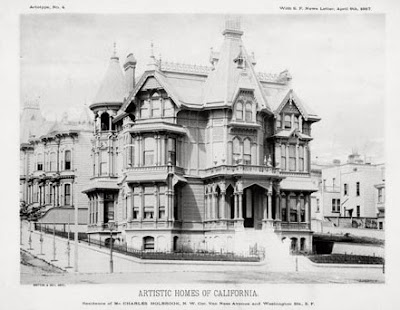
The Holbrook Home in San Francisco
He build a spectacular home on the northwest corner of Van Ness Avenue and Washington Street, where he lived for almost forty years until it was destroyed by fire. He also donated money to build the library at the Pacific School of Religion in Berkeley.

He died on July 25, 1925, at the age of 94.

After his death, he was honored for his contributions to society by having a 297-acre stand of redwood trees named after him just north of Garberville, which was added to the California State Park system.

Sources: "The San Francisco Bay Region" by Bailey Millard, Berkeley Daily Gazette, Oakland Tribune, The San Francisco Call, The Windsor Page, Wikipedia, Ancestry.com, "It Happened In Nevada: Remarkable Events that Shaped History" by Elizabeth Gibson

Saturday, April 1, 2017

Frederich Edwin Meese (1857-1933); Oakland City Councilman; City Treasurer

Ed Meese gravesite and obituary
Frederich Edwin Meese (1857-1933) was a Republican member of the Oakland City Council from 1899-1907 and later served as the City Treasurer.

Meese was born in San Francisco in 1857 to Herman and Catharina Meese, who traveled west around the Horn in 1850. He attended Lincoln Grammar School in San Fransisco, Concordia College in Indiana and graduated from the Heald Business College in 1876.

He worked as secretary of the Bay Sugar Refinery, which was owned by his father and was the first sugar refinery on the West Coast. He then went into the mercantile and insurance business, including a brief stint in Sacramento. He was a member of the Board of Trade, the Nile Club and in 1905 became a founder of the Oakland Chamber of Commerce.

In 1898, he was elected from the Fourth Ward on Oakland's west side and later served as the at-large councilman. He served as chair of the City Council's Finance Committee. In his May 1907 election, he won by just nine votes after a recount.

The Meese Family plot at Mountain View Cemetery
In 1908, Richard B. Ayer resigned from his post as the City Treasurer & Tax Collector. He had been appointed to the position in 1906 then elected in 1907. Meese was appointed to the position on April 1, 1908 by Mayor Frank Mott. Allegedly Ayer resigned to continue in his personal business affairs, but it was noted that the whole thing was handled with great secrecy. Meese had already declared to run for the office in 1907. He was replaced on the Council by Frank Bronner, an accountant at the Central Bank.

In 1912, Meese was accused of graft in his post as Treasurer & Tax Collector and charges were brought in Superior Court by Rev. Robert Whitaker, pastor of the 23rd Avenue Baptist Church. Meese responded to the reverend by stating, "Thou shalt not bear false witness against thy neighbor - Ninth Commandment." It's unclear whether anything became of this.

Meese was an active member of Zion Lutheran Church and active in German Lutheran affairs in the state.

He died of a heart attack at his home in Oakland. The City Council adjourned in his memory on June 1, 1933.

His great-grandson Edwin Meese III served as Attorney General under President Ronald Reagan.

Sources: OaklandWiki, Oakland Tribune, Ancestry.com

Saturday, March 11, 2017

Malonga Casquelourd (1947-2003): Famous Congolese Dancer, Choreographer

Malonga Casquelourd and the arts center named in his honor
Plot 76, Grave 1067

Malonga Casquelourd was born on November 5, 1947 in Douala, Cameroon as Auguste Leonard Malonga

He started dancing as a young boy and by his teens was a member of the National Congolese Dance Company, touring Africa, Europe and the United States. He eventually joined the Le Ballet Diaboua in Paris as a choreographer and principal performer. In 1972, he moved to New York and co-founded Tanawa, the first Central African dance company in the United States.

In the mid-1970s, he moved to Oakland where he taught Congolese dance and drumming at CitiCentre Dance Theater at the Alice Arts Center. When the Alice Arts Center faced closure in 2002, Casquelourd led the effort to keep it open. He also taught African studies at San Francisco State University. 

Plot 76 where Malonga Casquelourd is buried
He was also the voice of the 'Baaka Leader' in the 2002 film "The Wild Thornberrys Movie." 

In 2003, while returning home from his niece's graduation party, he was hit head on by a car going in the wrong direction and was killed. The Alice Arts Center was renamed the Malonga Casquelourd Center for the Arts in his honor. 

SOURCES: IMDb, SF Gate, Oakland Tribune, Ancestry.com

Tuesday, March 7, 2017

James Raymond "Gimi" Lippi (1913-1942): Only British Commonwealth military burial

Lot 65, Grave 2741

There is only one known burial of a British Commonwealth war grave, which is that of Pilot Officer James Raymond Lippi. He was the son of Oaklanders Paul and Elvira (nee Fava) Lippi of Oakland.

He was American born in Santa Cruz, California in 1913, but in July 1942 he went to Canada and joined the Royal Canadian Air Force to serve in World War II. His occupation was listed at bottler and records show he may have been in the process of a divorce.

He was killed during a training fight in Vulcan, Alberta along with Flying Officer Almond Maynard Vandre in September 1942 and was returned to California for burial. It is unclear why he went to Canada, but his death certificate from the Royal Canadian Air Force states the he "...exhibited a copy of the certificate of his birth in the United States and declared his willingness to serve but took no oath of allegiance."

He was posthumously awarded the General Service Medal and the Canadian Volunteer Service Medal.

SOURCES: Ancestry.com, Royal Canadian Air Force records, Veterans Affairs Canada, Winnipeg Free Press