Sunday, November 13, 2016

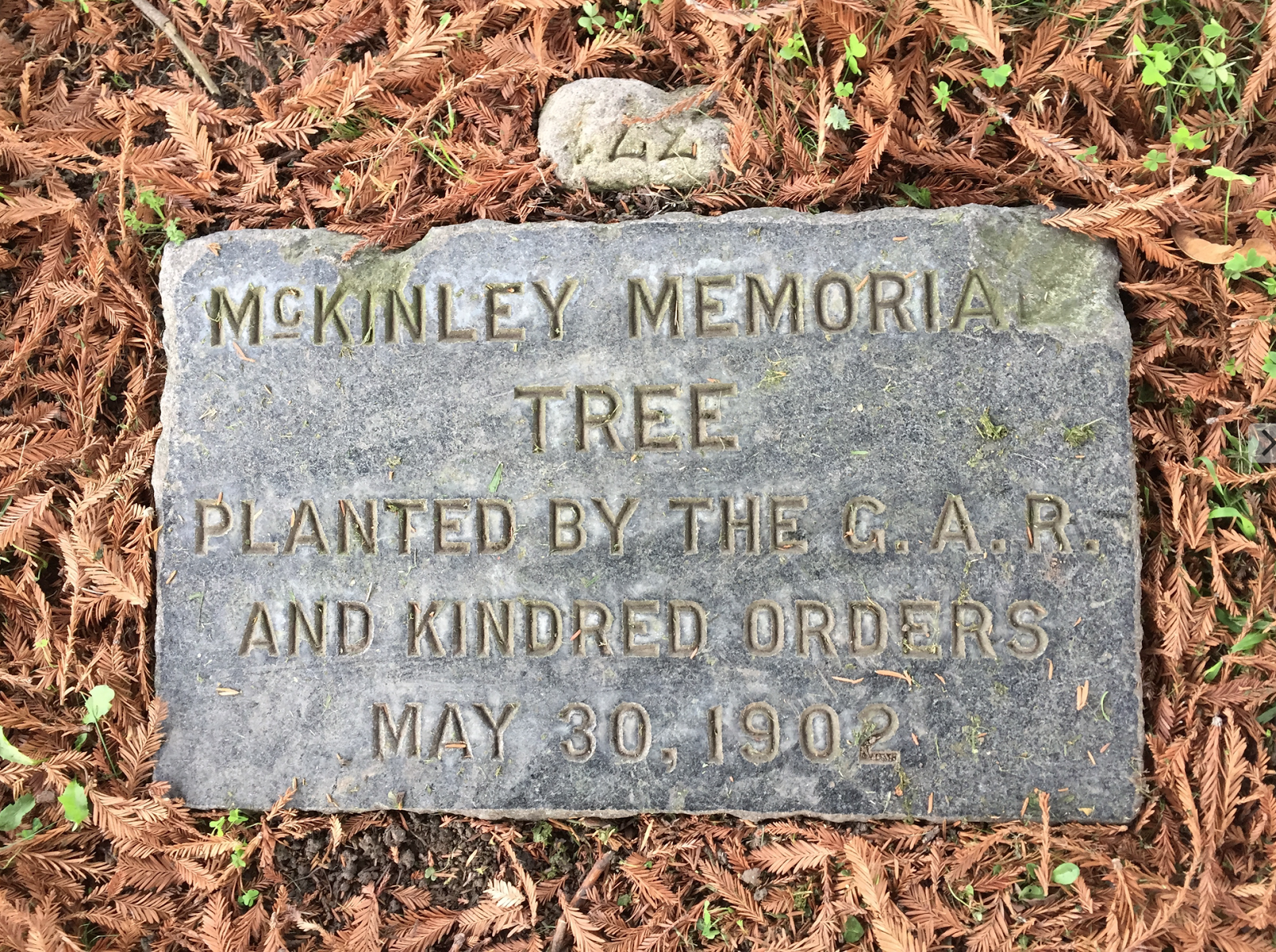
The McKinley Memorial Tree

The McKinley Memorial Tree
The McKinley Memorial Tree was dedicated on May 30, 1902 under the auspices of    Company A, Veteran Reserves of the Grand Army of the Republic. The tree was planted in memory of President William McKinley, who was assassinated on September 14, 1901, six months into his second term.

Speakers at the tree planting included Senator G.R. Lukens and former Oakland Mayor George Pardee, who would become California's governor in the November election. 


The original tree was a Giant Sequoia (Sequoia gigantea), which is no longer present. According to docent and tree expert Chris Pattilo, the current tree is a Coastal Redwood (Sequoia sempervirens). The tree was planted with soil from historic battlefields by local school children, as the Elks Quartette performed. 

The site has become a common location for annual Memorial Day tributes.

Monday, November 7, 2016

James Gimbel (1887-1918): Died of influenzu while serving in World War I

James Gimbel (Left: Gimbel Family; Right: Michael Colbruno)
The Great Influenza Pandemic of 1918-19 killed about 20 million people, far more  than the 17 million who died in the war. According to the Deseret News, an estimated 675,000 Americans died of influenza during the pandemic, ten times as many as in WWI. Of the U.S. soldiers who died in Europe, half of them fell to the influenza virus and not to the enemy. Berkeley resident James Gimbel was one of them.

The close quarters and massive troop movements of World War I hastened the pandemic and probably both increased transmission and augmented mutation. The war may also have increased the lethalness of the virus and some speculate the soldiers' immune systems were weakened by undernourishment, as well as the stresses of combat and chemical attacks.

After being drafted, Gimble ended up in France via Camp Kerney in San Diego, Arizona, Canada and eventually England. In a letter to his parents, he bemoaned the fact that he was too ill to help a fellow Berkeley soldier who was lying on the ground. He died in France on November 17 of the flu.

Sources: Gimbel family history; Berkeley Gazette; Wikipedia

Carl Castlemann Jones (1892-1918): Baseball player killed in WWI

Carl Jones (grave photo by Michael Colbruno)
PLOT 45 

Carl Castlemann Jones was a semi-professional baseball player who was killed in WWI. 

He born in Oakland in 1892 to Ada and Fred Soule Jones. He was raised in Piedmont and became a noted baseball player in the area.  In 1914, he played second base for Bill Glavin’s Federals team which participated in a four-team league that played under artificial lights – still quite a novelty at that time.

During the winter of 1914/15, he played for the Dreier & Nevis team in the Oakland Merchant’s League. Then, during the summer of 1915, he played in the Carbon-Emery League in Utah, a league made up of coal mining teams. Jones led that circuit with a .387 batting average. 


In October 1915, he was signed by the Maxwell Hardware Company to play in the highly competitive semi-pro Oakland Tribune Midwinter League. His teammates that year included Carl Zamloch, who pitched for the Detroit Tigers in 1913 and remained in minor league baseball into the 1930s; Tom Fitzsimmons, who would play for Brooklyn in 1919; Ralph Croll, who would go on to play for the Oakland Oaks and Joe Devine, who had made a couple of appearances with the Oaks that summer.

In 1916, he received a lucrative offer from the Ambrose Tailors baseball team in Oakland, but that but ended up Jackson in Amador County, California, where he played throughout the summer. He joined Alameda in the Midwinter League in November 1916, then was appointed manager of the newly-formed Exeter Athletics in March 1917.

He was drafted into military service in September 1917, and was assigned to Camp Lewis at American Lake, near Tacoma, Washington. He served with Company K of the 363rd Infantry Regiment and in April 1918, where he asked friends back in Oakland for bats, gloves and uniforms to help him organize a baseball team. The Oakland Tribune responded by arranging benefit shows at Pantages Theater with all proceeds being used to buy equipment for troops.

Jones played shortstop for the 363rd Regiment baseball team at American Lake, but the season was short-lived as the regiment, as part of the 91st Division, was on its way overseas and arrived in France in June 1918.

Sergeant Carl Jones was killed in action during the Battle of the Argonne Forest in October 1918. The Battle of the Argonne Forest (also known as the
Meuse-Argonne Offensive), was a major part of the final Allied offensive of World War I that stretched along the entire Western Front. 

The battle was fought from September 26, 1918, until the Armistice of November 11, 1918, a total of 47 days. The battle was the largest in United States military history, involving 1.2 million American soldiers, and was one of a series of Allied attacks known as the Hundred Days Offensive, which brought the war to an end. 

The battle cost 28,000 German lives and 26,277 American lives, making it the largest and bloodiest operation of World War I for the American Expeditionary Force, which was commanded by General John J. Pershing. American losses were exacerbated by the inexperience of many of the troops and tactics used during the early phases of the operation.


Friday, November 4, 2016

Isidore Giambruno (1889-1918): Bugler killed in WWI

Grave of Isidore Giambruno and a WWI recruitment poster with bugler

PLOT 45

Isidore Giambruno was born in New Orleans and shows up in Oakland records as early as 1905, the year that his father Reverend Giovanni Battista Giambruno died. In the 1910 Oakland Directory he was listed as a meat cutter and in the 1916 Directory as chauffeur.

He was drafted into the Army, served as a bugler, and was killed in action in September 27, 1918 at the Battle of Argonne. The American Expeditionary Forces lost 26,277 men and saw another 95,786 wounded at the infamous battle.

He was serving with Company D, 363rd Infantry 91st Division under Brigadier General Frederick S. Foltz and Major General William H. Johnston.  His unit fought in the Meuse-Argonne Offensive and successfully helped to destroy the German First Guard Division and continued to smash through three successive enemy lines.

A month after Giambruno died and twelve days before the end of World War I, his division, as part of the VII Corps of the French Sixth Army, helped drive the Germans east across the Escaut River. The division was awarded separate campaign streamers for its active role in the Lorraine, Meuse-Argonne and Ypres-Lys campaigns.

Isidore Giambruno
His body was not returned to the United States until October 1921, when he was buried with military honors by members of Oakland Post No. 5 of the American Legion at Mountain View Cemetery.

We don't know if Giambruno played taps on his bugle for any of his fellow soldiers, but it is likely. Taps is a bugle call played at dusk, during flag ceremonies, and at military funerals by the United States armed forces. The official military version is played by a single bugle or trumpet.

The tune is also sometimes known as Butterfield's Lullaby, or by the first line of the lyric, Day Is Done. The tune is a variation of an earlier bugle call known as the Scott Tattoo, which was used in the U.S. from 1835 until 1860. It was arranged in its present form by the Union Army Brigadier General Daniel Butterfield, an American Civil War general and Medal of Honor recipient. Taps replaced a previous French bugle call used to signal "lights out."

Sources: US Military records, Ancestry.com, Oakland Tribune, Wikipedia,


Friday, September 30, 2016

Samuel S. Johnson (1857-1905): Millionaire lumber man

The Johnson Family Mausoleum at Plot 11
PLOT 11

Samuel Johnson was born in Malahide, Ontario, Canada on September 9, 1857. His family moved to Almont, Michigan when he was three years old. In 1879, he married Emma Almeda Gibbs with whom he had two sons, William and Samuel.

He came to Berkeley on a few years before his death in 1905 and established himself as a successful lumber man. Minneapolis millionaire J.H. Queal purchased the Scott & Van Aisdale lumber mills on the McCloud River in Siskiyou County and renamed them the McCloud Lumber Company. Queal made Johnson the president and general manager of the company, which was one of the largest on the West Coast.

The McCloud Lumber Company circa 1915

The McCloud Lumber Company circa 1915
At it's height, the McCloud River Lumber Company owned or controlled over 600,000 acres of timberland. The company had extensive logging operations that produced the logs needed to keep the sawmill running, along with an extensive railroad system connecting the woods operations with the mill. Some of the railroad system was owned and operated by the McCloud River Railroad Company, but the vast majority of the railroad operation were owned by the lumber company.

In July 1905, Johnson fell ill with Bright's disease, a condition involving chronic inflammation of the kidneys. Friends and business associates came from all over the country to be with him during his surgery and recovery, but he he died the following month. He is buried in the Johnson family mausoleum by the second fountain on Mountain View Cemetery's main road.


Sources: Meriam Library. California State University, Chico; Ancestry.com; San Francisco Call

Thursday, September 22, 2016

Jefferson Maury (1826-1895): Noted Ship Captain; Home landmarked by Berkeley

The Maury Plot near the Mountain View reservoir
PLOT 2

Jefferson Maury (1826 1895) was born in Virginia and may have been descended from Rev. James Maury, teacher of Thomas Jefferson, James Madison, and James Monroe and grandfather of Commodore Matthew Fontaine Maury, known as the father of modern oceanography and naval meteorology.

Maury entered the U.S. Navy at the age of 15 and received his warrant as a Passed Midshipman in 1847. The following year found him in the Gulf Squadron, participating in the Mexican-American War. In 1854 he was stationed in San Francisco and a year later left the service.

It is not known when Maury joined PMSS, but shipping records indicate that in 1862 he commanded the company s S.S. Northern Light, a wooden-hulled steamer with side paddle wheels and three masts on a sailing between Aspinwall, Panama and New York.  In the 1860s, he was relieved of his duties when his ship ran ashore in China, despite an investigation showing that it was not through an error on his part.

He eventually became captain of the S.S. America, followed by the S.S. Atlantic, both plying the same route.  From 1866 until 1870, Maury was master of the S.S. Arizona, which his future neighbor, Captain Seabury, would take over in 1874.  At one time he was the oldest person to hold the title of Commodore in the fleet.

The Captain Maury house was designated a City of Berkeley Landmark in 1982 (photo: Daniella Thompson, 2004)
In 1894, when Captain John Slater built his house at 1335 Shattuck Ave., he was joining two other master mariners who had settled on the same block a decade earlier. They were Jefferson Maury and William B. Seabury, both high-ranking captains of the Pacific Mail Steamship Company who ended their careers as Commodores of the PMSS fleet. While Captain Slater commanded square-rigged ships, Captains Maury and Seabury were at the forefront of the mechanized age.

Captain Maury died suddenly at midnight on January 1, 1895. The Berkeley Advocate reported that he had suffered from heart disease. His wife, Adelaide Maury, continued living in their home at 1317 Shattuck Avenue in Berkeley until her death in 1916.

[Biography taken from the Berkeley Architectural Heritage Association and Martime Heritage. Additional information from the Berkeley Gazette].
Jefferson

Tuesday, September 6, 2016

Andre Louis Hicks (July 5, 1970 – November 1, 2004) aka "Mac Dre": Rap Artist Gunned Down After Concert

Gravesite of Mac Dre
 [By request, the Lot and Plot number are not disclosed]

Andre Hicks, who was known as "Mac Dre," was born in Oakland and grew up in Vallejo. He was an American rapper, and the initial founder of Thizz Entertainment, and the now defunct Romp Productions. Mac Dre recorded his first three EPs albums between 1989 and 1992.

In 1992 Mac Dre was charged with conspiracy to commit robbery and was sentenced to 5 years in federal prison after he refused the deal the police had offered him, which was informing law enforcement about his partners. While in Lompoc, Mac Dre would go on to obtain his G.E.D. and record his album "Mac Dre Presents: The Rompalation" over the phone, taunting law enforcement officials. After his release from prison in 1997, he recorded his second album Stupid Doo Doo Dumb.

Mac Dre's "Thizzle Dance":

Mac Dre was killed around 3:30 AM on the morning of November 1, 2004, on U.S. Route 71 in Kansas City, Missouri. Along with members of Thizz, he was scheduled to perform in Kansas City on October 31, but the group had a dispute with the club promoter about their payment. A group of unknown assailants in a stolen black Infiniti G35 began shooting at the white van in which Hicks was a passenger. The driver crashed and was able to get to a phone to call 911, but Hicks was pronounced dead at the scene from a bullet wound to the back of the neck from an AK-47.

The case has remained unsolved for years, but police believe that fellow rapper Anthony "Fat Tone" Watkins was the likely person to call for the hit. Six months later, a San Francisco rap promoter nicknamed "Mac Minister" and a friend avenged Hicks in Las Vegas by firing 33 assault-rifle rounds into two Kansas City men, including Anthony "Fat Tone" Watkins, who was killed.

The viewing was held at Mount Calvary Baptist Church in Fairfield, California to a packed crowd of 2,000 people. When the body was moved to Mountain View Cemetery there was a near riot, as only 100 people could fit into the chapel for the service. Allegedly, even the singer's father had a difficult time gaining entry. The service was officiated by former Oakland Raiders running back and Pastor Jerone Davidson of Fairfield's Bountiful Harvest Ministry Church. Mac Dre was buried in a platinum-plated, stainless steel basket lined with cardinal red crushed velvet, protected by a fiberglass shield. Visitors commonly visit his graveside under a hillside oak tree an leave mementos. His notoriety and fame have only grown in death and his tombstone has been stolen on at least one occasion.

SOURCES: Oakland Tribune, Wikipedia, San Francisco Chronicle, Rap News Network

Sunday, August 28, 2016

Earl W. Smith (1908-2000): Developed "Flat Top" home; Influenced Eichler

Earl W. Smith
Earl W. Smith's was a pioneer in the construction of affordable housing, who is best remembered for designing and building the "Flat Top" home. He developed the home in 1947 in order to open the door to home ownership to thousands of post World War II Californians. The key to the design was a flat topped home built atop a concrete slab.

The home was so popular that it appeared in the September 10, 1951 issue of LIFE magazine in a feature on the "Best Houses under $15,000." After  World War II, building supplies were scarce and President Harry Truman had signed a bill easing down-payment requirements. Smith seized on the opportunity building over 2,000 homes a year that ranged in price from $6,795 for a two-bedroom home to $8,250 for a deluxe three-bedroom home with 1,300 square feet of living space. Smith estimated that the flat top roof saved him about 4% on building costs.

Part of the feature on Earl Smith that appeared in the September 10, 1951 issue of LIFE
Smith was dubbed "Flat Top" after the popularity of his homes took off. Many of the homes were built in El Cerrito, El Sobrante and Richmond, California. His design had a great influence on both two noted builders of homes,  California’s Joseph Eichler and Kansas City's Donald Drummond.  Eichler closely studied the construction techniques of Smith, particularly the poured concrete floors  and flat roofs and modeled his earliest housing development, the 104-unit Sunnyvale Manor, on Smith's designs.

Smith eventually switched to building California's first zero-lot line homes in the 1960s. These also allowed him to cut costs by building the more tradition-style home but with low-pitched roofs and "compact" lot placement allowing families to buy into the "American Dream."

In the early 1940's, Smith was one of the founding members of the Association of Home Builders of the Greater East Bay. This group represented home builders in Alameda and Contra Costa Counties, and soon joined six other associations in the state to form the then Home Builders Council of California. He became its President in 1948.

In 1955, "Flat Top" was elected President of the National Association of Home Builders. As President, he brought about the first official "people to people" exchange with representatives of the Soviet Ministry of Construction and the heralded "Homes for Korea" program. In later years, he also helped establish an improved housing industry for the country of Equador.

​In 1978, Mr. Smith was inducted into the National Housing Hall of Fame. He was honored by the National Association of Home Builders Research Institute for promoting "improved building techniques, more economical construction methods, and fundamental improvements in the standard of American housing."

Smith was also a Regent of St. Mary's College in Moraga, where he also served as a guest lecturer in the Graduate School of Business.

Sources: "El Sobrante’s Canyon Park Neighborhood – The “Flat-top” Smith Legacy" by Maurice Abraham, El Sobrante Historical Society, California Homebuilding Foundation, LIFE magazine, Eichler: Modernism Rebuilds the American Dream by Paul Adamson

Sunday, August 7, 2016

Lucius Anson "L.A." Booth (1820-1906): Railroad pioneer; Grocery mogul

Booth Family plot at Mountain View Cemetery
New York native Lucius Anson Booth, was a Forty-Niner  who arrived in California via Mexico.

He was one of the original incorporaters of the Central Pacific Railroad with the Big 4 - Leland Stanford, Mark Hopkins, Charles Crocker and Collis B. Huntington. In 1860, the five men, along with Theodore Judah, James Bailey, Charles Marsh and John Marshall, learned about an unused wagon trail across Donner Pass. They decided to organize the Central Pacific Railroad and funded the survey that convinced Congress to approve the Western portion of the transcontinental railroad. The Pacific Railway Act was passed by Congress in July 1862 and signed into law by President Abraham Lincoln.

The nine men bickered about numerous business issues and the board often split 4-4 on key votes (with Marsh often absent). The company faced numerous financial and technical challenges, including the inability to find workers after the Civil War. Over the next six years, the Central Pacific brought in 13,000 workers who were mostly Chinese. The immigrant workers laid 690 miles of track over the Sierra Nevada's and over 1,500 died from avalanches, freezing weather and dynamite explosions while making tunnels. They were paid $26 a month and had to buy their own rations.

Booth & Co. on J Street in Old Sacramento
Booth made a fortune in mining, which he invested in founding a wholesale grocery business on J Street in Sacramento, which at various times was known as Booth & Company, Booth, Adams & Company and Forshee, Booth & Company. One of the investors in the business was his cousin Newton Booth, who was the 11th Governor of California.

In April 1877,  he became an investor in James Gamble's 350-acre tract of land that he purchased from Walter Blair, which became the Piedmont Land Company. The property was subdivided and sold to individual land owners.

He died at his residence, known as Hazelwood, on Hazel Lane in Piedmont.

[Sources: "Historic Donner Stock Trail" by Milan E. Wight; Oakland Tribune; San Francisco Call; "History of Sacramento County" by G. Walter Reed; "Classy  City: Residential  Realms  of  the  Bay  Region" by Richard Walker; Wikipedia; Bancroft Library; Ancestry.com]

Roi Partridge (1888-1984): Noted printmaker and teacher; Married Imogen Cunningham


Roi Partridge in 1952 (photo: Paul Bishop) and in 1915 (Photo: Imogen Cunningham)
PLOT 11

Roi George Partridge (October 14, 1888 – January 25, 1984) was an American printmaker and teacher. He was born in Centralia in the territory of Washington on October 14, 1888. At age four he moved with his family to Seattle, Washington, where his father worked as a typesetter and later owned the local newspaper.

Roi Partridge is buried in his wife's Fisher family plot
In Seattle, Partridge was one of three Seattle artists who worked together under the name "The Triad". The others were painter John Butler and miniaturist Clare Shepard Shisler. Also in their circle were photographer—and Partridge's future wife—Imogen Cunningham, and painters Mabel Lisle Ducasse and Yasushi Tanaka.
Roi Partridge's Santa Rosita (Hollister Peak) - 1923
In 1909 the budding artist traveled with Butler to New York City for one year of art study at the National Academy of Design and then studied etching in Munich. His next three years were spent in Paris where he worked as a printmaker under the mentorship of Bertha Jaques. When the German troops were approaching the French capital in 1914, Roi returned to Seattle. When 44 of his etchings were shown at the Panama-Pacific International Exposition in 1915, he decided to make California his home. After moving to San Francisco in 1917, he began teaching at Mills College in Oakland, California in 1920 and became the first director of the school's art gallery. His marriage to photographer Imogen Cunningham in 1915 ended in divorce in 1934. They had three sons, including photographer Rondal Partridge. His second wife, artist Marion Lyman, died of cancer in 1940; his third wife was May Fisher.

Partridge took a leave of absence from Mills College in 1946, continued etching until 1952, and retired in 1954. His last years were spent in Rossmoor in Walnut Creek, California, where he died on January 25, 1984.
Roi Partridge's California Coast -1924–1925
The Amarillo Museum of Art (Amarillo, Texas), the Bancroft Library (University of California), the British Museum, the Brooklyn Museum, the Honolulu Museum of Art, Mills College, the Mobile Museum of Art (Mobile, Alabama), the New York Public Library, the Oakland Museum, the San Diego Museum of Art (San Diego, California), the University of Michigan Museum of Art (Ann Arbor, Michigan) and the Weisman Art Museum (University of Minnesota) are among the public collections holding works by Roi George Partridge.

[REPRINTED FROM WIKIPEDIA]