Saturday, March 29, 2025

Bernard Crosby Whitman (1828-1885): Chief Justice of the Nevada Supreme Court

Chief Justice Bernard Whitman and Grave Marker

Plot 21 Lot 2

Bernard Crosby Whitman (1827–1885) was a prominent figure in 19th-century law and politics, leaving an indelible mark on both California and Nevada during his career. Born in Waltham, Massachusetts, Whitman was the son of attorney Levi Whitman and the nephew of Ezekiel Whitman, a Chief Justice of Maine's Supreme Judicial Court. He graduated from Harvard College in 1846 and pursued legal studies under the mentorship of the Portland, Maine law firm Fessenden & Deblois before being admitted to the bar in 1849.

Whitman moved to San Francisco, California, in 1850 during the Gold Rush era. He quickly became involved in law and politics, serving as a member of the California State Assembly when the state capital was located in Benicia. His tenure as a legislator coincided with a transformative period for California as it worked to establish its governance structures. After his time in the legislature, he served as the Benicia City Clerk, further contributing to the development of this early California capital.

In 1864, Whitman relocated to Virginia City, Nevada, during the height of the Comstock Lode mining boom. His legal expertise positioned him as a key figure in litigation surrounding mining claims and disputes, which were central to the region's economy at the time. His reputation for integrity and skill earned him an appointment to the Nevada Supreme Court in 1868. Whitman served on the court for over six years, including a term as Chief Justice from 1873 to 1874. As Chief Justice, he was lauded for his quick grasp of complex cases, thorough knowledge of legal principles, and unwavering commitment to justice.

Mary Elizabeth Church Whitman and Crosby Church Whitman, who are also listed on the grave marker, were integral parts of Bernard Crosby Whitman's family, each contributing to the family's remarkable legacy. However, these are likely cenotaphs, as Crosby was cremated and buried at Suresnes American Cemetery outside of Paris, while records show his mother's ashes were brought to the American Cathedral in Paris.

Mary Elizabeth Church was born in Albion, Michigan, in 1842 and moved to California as a child, settling in Nevada County. She married Bernard Whitman on July 14, 1858, when she was just 16 years old. Their union marked the beginning of a partnership that spanned Bernard's political and legal career. Mary Elizabeth was educated at Mills College when it was known as the Benicia Female Seminary. 

Crosby Whitman's ashes are likely in France
Crosby Church Whitman, their only child, was born in Benicia in 1864 during Bernard's tenure as a legislator and city clerk. Crosby pursued an illustrious career in medicine after graduating from Harvard College in 1886. He studied medicine in France and Germany and practiced briefly at Johns Hopkins before dedicating much of his life to medical service in France. Crosby became one of the founding physicians of the American Hospital in Neuilly-sur-Seine near Paris. During World War I, he organized a field hospital under the French Red Cross to treat wounded soldiers. His tireless efforts during the war eventually led to his death from exhaustion in 1916.

In private life, Whitman was admired for his refined manners and dedication to his family. His colleagues remembered him as a kind and courteous associate whose contributions enriched Nevada's legal system. After retiring from public service in Nevada, he returned to California in 1882 and continued practicing law until his death from an apoplectic stroke on August 5, 1885.

Friday, March 28, 2025

Captain Aaron Milton Burns (1826–1912): Gold Rush Mariner Involved in Famous Act of Vigilante Justice

Captain Aaron Burns and Grave Marker

Plot 9, Lot 19 

Captain Aaron Milton Burns was a central figure in the story of early California—a man whose life bridged the lawless chaos of Gold Rush San Francisco and the growing push toward civic order. Born in 1826, Burns arrived in the city during its most turbulent years, where he earned a reputation both as a fearless sea captain and as a citizen committed to public integrity.

As skipper for the Pacific Mail Steamship Company, Burns ferried prospectors, merchants, and adventurers from Panama through the Golden Gate, navigating treacherous waters and booming demand. He commanded steamships up the Sacramento River during the height of the Gold Rush, when San Francisco’s waterfront was lined with abandoned ships and the streets teemed with gamblers, fugitives, and dreamers.

But it was on land that Burns's name became etched into San Francisco's civic history. In 1856, he played a role in one of the most consequential episodes of frontier justice: the hanging of gamblers Charles Cora and James P. Casey by the Second Committee of Vigilance. Burns was one of twelve men assigned to guard Cora while he awaited judgment—not in a court of law, but before a citizen-led tribunal.

The hanging of Charles Cora and James Casey
The drama began the year prior when Charles Cora shot and killed U.S. Marshal William H. Richardson. Cora’s lavish lifestyle and political connections led many to fear that justice would be subverted, especially after his trial ended in a hung jury. Then, in May 1856, the situation exploded when James King of William, a crusading newspaper editor, was gunned down in broad daylight by Supervisor James P. Casey—an act of political retaliation after King had published damning reports about Casey’s criminal past.

King’s murder was the final straw. Outraged citizens, already furious at the corruption and lawlessness plaguing their city, reactivated the Committee of Vigilance. Within days, thousands had joined. They arrested both Cora and Casey, tried them in a private tribunal, and hanged them side by side before a massive crowd. Captain Burns, a respected civic figure even then, stood guard over the process—ensuring it would not be interrupted.

In the decades that followed, Burns transitioned from maritime work to insurance and business. He remained deeply involved in public life, culminating in his election to the San Francisco Board of Supervisors in 1887, during the administration of Mayor Washington Bartlett.

Captain Burns lived to the age of 86, passing away in 1912 at San Francisco’s Hotel Bellevue. At the time of his death, he was the last surviving skipper of the early Pacific Mail fleet and one of the few living witnesses to the transformation of San Francisco from a wild frontier town into a city governed by law, order, and civic vision.


Emelie Swett Parkhurst (1863–1892): Literary Advocate and Organizer for Women Writers

Emelie Swett Parkhurst and Grave Marker

Plot 30

Emelie Tracy Young Swett Parkhurst was a gifted American poet, writer, editor, and tireless advocate for women in literature. Born in San Francisco on March 9, 1863, she was the daughter of John Swett, a pioneering figure in California’s public education system. Emelie showed literary promise from an early age, receiving her education from private tutors and public schools before graduating from the Normal School. She would go on to teach French, Greek, and music at a women’s college, while simultaneously launching her career as a writer.

At just sixteen, Emelie earned her first public recognition by winning a prize for a Christmas story published in a daily newspaper. This success set her on a prolific path, contributing poetry and prose to The Call, Bulletin, Overland Monthly, and other prominent San Francisco and Eastern publications. Her work was known for its elegance and emotional clarity, often bridging literary and journalistic styles. She translated French, German, and Greek works, and adapted Helen Hunt Jackson’s novel Ramona for the stage. Her talents extended to editing, and she served as assistant editor of the Californian Illustrated Magazine during the final year of her life.

Swett Parkhurst's literary accomplishments were matched by her commitment to supporting other writers, especially women. She founded a literary bureau to help place the works of Pacific Coast women with publishers, and from that endeavor emerged her most lasting contribution: the Pacific Coast Women’s Press Association (PCWPA). As its founder and leader, she became a central figure in fostering a professional network for women journalists and authors, offering mentorship and promoting higher standards of literary achievement. Newspaperwomen across the West Coast responded to her call for solidarity and professional development.

Collection of works by PCWPA members
In 1889, she married John W. Parkhurst, a Bank of California employee. Her promising life was tragically cut short just three years later. After giving birth to a daughter on April 1, 1892, Emelie fell gravely ill. Despite hopes of recovery, she passed away on April 21, at the age of 29. Her death, following complications of childbirth, was sadly not uncommon for women of her time. In the late 19th century, maternal mortality remained a major health risk; medical understanding of infection and postpartum care was still limited, and childbirth was one of the leading causes of death for women of childbearing age.

The loss of Emelie Swett Parkhurst was deeply felt by the literary and journalistic communities she had so vigorously championed. Her legacy lives on through the institutions she built and the many lives she inspired.

Thursday, March 27, 2025

"Captain" Andrew Williams (1813 or 1814–1871): Oakland Mayor & Bret Harte's Stepfather

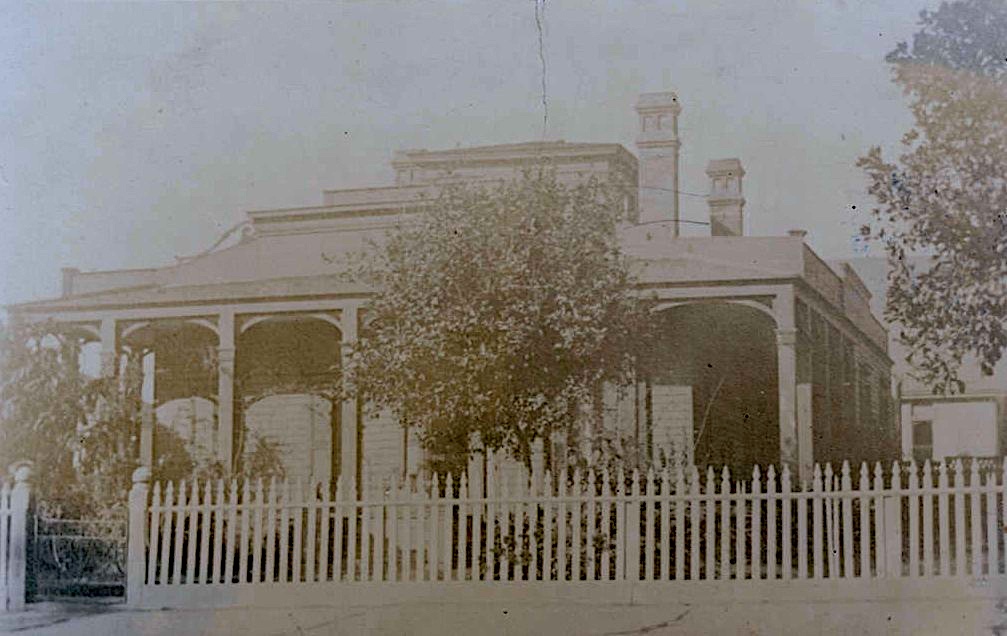
The home of Andrew Williams, 5th and Clay Streets, Oakland. Bret Harte lived there during his childhood. 
 Lot 19, Plot 8

Captain Andrew Williams (1814–1871) was a prominent early civic leader in California and served as the 4th Mayor of Oakland from 1857 to 1858. A native of Cherry Valley, New York, Williams moved west during the transformative years of the California Gold Rush. He was frequently referred to as “Captain,” a title likely connected to militia or community leadership, as was common for respected men in early American frontier society.

Oakland had been incorporated in 1852 and, the city was transitioning from a small settlement into a more structured municipality. By the late 1850s, there was growing interest in expanding port facilities and rail connections, which would later lead to the development of the Central Pacific Railroad terminus in the 1860s. This period was also marked by land disputes between settlers, speculators, and original land grantees. The legal status of Rancho San Antonio (which much of Oakland was built on) continued to generate litigation and conflict during this time. In 1858, Oakland was beginning to see the establishment of more formal schools, and efforts to organize religious and civic institutions were gaining traction.

Before settling in California, Williams had been active as a teacher and Unitarian minister, and he became part of the intellectual and civic fabric of Oakland during its formative years. His contributions helped shape the city’s early governance and public life.

Williams is also remembered as the stepfather of Bret Harte, the celebrated American writer best known for his vivid short stories about the California Gold Rush, including “The Luck of Roaring Camp” and “The Outcasts of Poker Flat.” Williams married Elizabeth Ostrander Harte, Bret Harte’s mother, during the boy’s youth. Their relationship was reportedly strained, and young Harte left home at an early age, later achieving literary fame in California and abroad.

Ashmun Cooke Henry (1828–1907): Mayor of Oakland, Banker, Pioneer Entrepreneur

Ashmun Henry obituary and grave marker
 Plot 12

Ashmun C. Henry was a pioneering Californian businessman and civic leader whose political and entrepreneurial legacy helped shape 19th-century Oakland. Born on December 6, 1828, in Millersburg, Ohio, he was the eldest son of Samuel S. Henry, a merchant and early Ohio state legislator. Raised amidst the rigors of frontier enterprise, Ashmun benefited from both his father’s business experience and public service example.

In 1851, drawn by opportunity in the West, Henry sailed aboard the North American to San Francisco. After a brief stay, he established himself in Georgetown, El Dorado County, and soon after moved to Placerville. He prospered during the early gold rush economy, and when silver was discovered in Nevada's Washoe region, Henry organized a company that constructed a key wagon road linking El Dorado to Placerville and onward through the Sierra Nevada to the booming silver mines. This “River Road” would be praised as “one of the finest mountain highways ever constructed in the state.”

Henry’s contributions to transportation continued when he became one of the original founders and incorporators of the Placerville and Sacramento Valley Railroad, aiming to connect the mining regions with key markets and ports.

Following a return visit to his family in Ohio in 1856, Henry settled permanently in Oakland, California, then a small but growing city on the eastern shore of San Francisco Bay. Recognizing the city’s need for financial infrastructure, he established the Oakland Bank of Savings—the first banking house in Alameda County—with a capital of $150,000. He served as its president until 1869, when he helped organize both the Union Savings Bank and the Union National Gold Bank, presiding over the latter. His reputation as a prudent banker and civic leader grew in parallel with Oakland’s rise.

The Horton School opened during Ashmun Henry's mayorality
 

A committed Republican, Henry entered local politics during a time of fierce party competition. In 1884, he defeated the Democratic incumbent, J. West Martin, to become Mayor of Oakland, winning 2,531 votes to Martin’s 2,216. His victory was seen as a triumph for the city’s business-minded reformers. During his term Oakland's educational and cultural landscape began expanding, including the founding of the Horton School, a private school for girls (that later became coed).

Following his mayoral term, he was elected as both city clerk and city treasurer from 1887 to 1888, continuing his public service with characteristic efficiency and integrity.

Throughout his adult life, Henry resided at 1221 Harrison Street, a home he occupied from before his election as mayor until his passing. He died on January 15, 1907

Wednesday, March 26, 2025

Daniel DeWitt.Tompkins Nestell (1819-1900): Civil War P.O.W & Notable Physician

Luty Family Plot and Daniel Nestell, M.D.

Plot 15, Lot 65 - Luty Family Plot

Daniel D. T. Nestell was born in New York between 1815 and 1819. He pursued a career in medicine, graduating in 1843 with honors from the University of the City of New York's University Medical College (later known as the New York University School of Medicine). Following his graduation, Nestell traveled abroad for two years to further his medical studies, accompanied by one of his professors, Dr. Valentine Mott.

Upon returning to the United States, Nestell worked as a physician or apothecary until 1862. On January 25, 1862, he was appointed Acting Assistant Surgeon on the U.S.S. Clifton, participating in several significant battles during the American Civil War, including the Battle of Forts Jackson and St. Phillip (the decisive battle for possession of New Orleans) and the Siege of Vicksburg. He was captured by Confederate forces at Sabine Pass, Texas, in September 1863 and held as a prisoner of war until January 1864.

U.S.S. Clifton during the Civil War

 
After his release, Nestell was assigned to the U.S.S. Alabama, where he served in the North Atlantic Blockading Squadron. During the Union attacks on Fort Fisher, he suffered irreversible hearing damage. His appointment as Acting Assistant Surgeon was revoked on June 6, 1865, and he was honorably discharged from the Navy in August of that year.

Nestell later received an appointment as Acting Assistant Surgeon in the U.S. Army on September 9, 1869, serving at Camp Warner, Oregon, until April 1871. He briefly served in California and the Arizona Territory before returning to civilian life in May 1872. Nestell then practiced medicine privately in California.

Daniel D. T. Nestell married Maria Louisa Whaites in 1864 and had a daughter named Ella. He passed away on October 24, 1900 and his cause of death was listed as "senility." He is buried in the Luty Family plot with no notable marker. The 1880 census shows him living with Frederick Luty, who is identified as his son-in-law.

Tuesday, March 25, 2025

F. McGrew Willis (1891–1957): Screen Writer in Early Hollywood


F. McGrew Willis and Midshipman movie poster

Plot 36, Lot 268 W ½ - Wilson Family Plot

Frank McGrew Willis was a prolific American screenwriter and occasional producer whose career spanned the silent and early sound film eras. Born Frank McGrew Willis in Pleasanton, Iowa, he emerged as a prominent voice in early Hollywood, beginning his career writing film shorts in 1914 and 1915. His first credited feature film, The Quest, appeared in 1915, launching a productive career that included screenwriting or story credits for more than 60 films over three decades.

Willis made his mark in the silent film industry with 43 scripts or stories, including The Girl in the Pullman (1927), Annapolis (1928), and A Blonde for a Night (1928). One of his most successful and enduring works was The Midshipman (1925), a romantic drama set at the U.S. Naval Academy and starring Ramón Novarro. The film was a significant box office hit and is often considered one of Willis’s biggest commercial successes. Notably, it also featured an early uncredited appearance by Joan Crawford, who would go on to become one of Hollywood’s most iconic actresses.

F. McGrew Willis and Secret Sinners movie poster

During this prolific period, Willis worked with major production houses such as De Mille Pictures and Pathé Exchange, and he occasionally produced films himself. In the late 1920s and early 1930s, he successfully transitioned into the era of talking pictures, continuing to write screenplays for another 18 films. He later spent time in England in the late 1930s, scripting six more features before returning to the U.S. for his final screenwriting credit on Sis Hopkins (1941).

Later in life, Willis settled in Menlo Park, California, in the San Francisco Bay Area. He died there in 1957 at the age of 66 and was buried at Mountain View Cemetery in Oakland, California. His work helped shape the formative years of Hollywood, bridging the silent and sound eras with a talent for storytelling that remains part of cinema history.

Willis was married to Viola Barry (nee Wilson), a prominent silent film actress known for her roles in early 20th-century cinema. He is buried in the Wilson family plot along with her father Jackson Stitt Wilson, the socialist Mayor of Berkeley, who died 1942; Violette Wilson, a noted B-actress, who died 1964; and, Irving Pichel, an actor and director who was blacklisted, who died 1954.


William "Will" Sharkey (1876-1948): Publisher and Politician


Will Sharkey's vault in Mausoleum

Main Mausoleum Section E, 36, T4

William Richard Sharkey, born on June 6, 1876, in Sierra City, California, was a notable figure in early 20th-century Californian politics and journalism. He married Nancy "Nannie" Elizabeth Gott in 1899, and they had two children: Muriel M. Hexner and William R. Sharkey Jr. Sharkey passed away on July 25, 1948, in Martinez, California.

His son, William R. Sharkey Jr., was born in San Francisco in 1903. He became one of the first officers of the California Highway Patrol (CHP), holding badge number 5. Sharkey Jr. played a pivotal role in developing vehicle safety regulations in the 1930s, including the development of the sealed beam headlight, which replaced the bulb-type headlamp used in vehicles at the time. After serving in the Navy during World War II, he became the publisher of the family-owned Contra Costa Gazette in 1948. 

Will Sharkey for State Senate Billboard
 

Will Sharkey's political career began with his election to the California State Assembly in 1914 as a member of the Progressive (Bull Moose) Party, representing the 18th Assembly District. He later transitioned to the Republican Party and was elected to the California State Senate in 1916, representing the 9th Senate District. He was re-elected in 1920, 1924, and 1928. Following redistricting, he represented the 17th Senate District after winning the 1932 election. 

His legislative successes included the creation of the Mt. Diablo and Mt. Tamalpais State Parks, championship of the Central Valley Water Project and the development of highway, labor and school legislation. His Senate district included parts of Marin County.

In addition to his political endeavors, Sharkey made significant contributions to journalism. In the 1920s, he served as the editor and manager of the Martinez Daily Standard and the Contra Costa Daily Standard. Under his leadership, these publications played a crucial role in informing the public and shaping community discourse in Contra Costa County. 

Dr. Penelope “Penny” Vrachopoulos (1922-2019): Founder of Gilbert & Sullivan Theater Company


Grave Marker for Penny Vrachopoulos

Plot 13

Dr. Penelope Helen Vrachopoulos, was a gifted musician, educator, and pioneering director. Born in New York City to Emmanuel and Theresa Vrachopoulos, Penny pursued a life steeped in music and scholarship. She studied at Queens College and Columbia University, ultimately earning her Doctorate in Music from Stanford University in 1971—cementing a lifelong connection to the Bay Area.

Her distinguished teaching career spanned several respected institutions, including Cornish College of the Arts, SUNY Potsdam, and Washington State University. Known for her fierce dedication to her students, Penny inspired generations of young musicians to pursue their craft with discipline, heart, and humor.

In 1972, Penny founded The Peccadillo Players, a Gilbert & Sullivan repertory company in Bellevue, Washington, which she led for nearly four decades. Under her baton, the group staged all 14 comic operas in the G&S canon, delighting Pacific Northwest audiences and introducing many to the delights of rarely performed works. She also founded The Bellevue Opera and the chamber opera company Eastside Lyric Theatre, further nurturing the operatic arts in the region.

Posters for the Peccadillo Players
 

Beyond her musical achievements, Penny had a remarkable eye for talent. She played a pivotal role in launching the careers of many outstanding performers, including NY Metropolitan Opera tenor Rob McPherson, Berlin Opera mezzo Julia Benzinger, Broadway star Megan Hilty, TV personality Mary Votava, and Hollywood actress Deidre Kilgore. 

Penny’s love for music and performance also lived on in her family. Her daughter, Penelope Houston, became a central figure in the San Francisco Bay Area’s punk and folk scenes. As the lead singer of the seminal punk rock band The Avengers and later as a solo artist, Houston carved out her own legacy—recording albums like On Market Street at Berkeley’s famed Fantasy Studios. It was a different genre, but the same fierce spirit of artistry that Penny passed on.

Though her most public work took place in the Pacific Northwest, Penny remained deeply connected to the Bay Area, both through her academic roots at Stanford and her later years in Oakland. Her funeral service was held on July 22, 2019, at Mountain View Cemetery in Oakland and was attended by a vast community of artists, musicians, students, and collaborators whose lives she touched.

Monday, March 24, 2025

Major John Lewis Bromley (1820-1909): Soldier, Pioneer, and Civic Leader


John Bromley and Family Plot

Plot 14B Lot 64

Major John Lewis Bromley (1820–1909) lived a life of service, sacrifice, and dedication to his country and community. Born on December 24, 1820, in Maryland, Bromley would go on to fight in one of the most pivotal conflicts of the 19th century—the Mexican-American War—and later become a respected figure in California’s civic and veteran communities.

Bromley enlisted in the U.S. Army in Memphis, Tennessee, joining the 14th Infantry Regiment during the Mexican War. He began his military career as a recruiting sergeant and quickly rose through the ranks to become orderly sergeant of Company G. His regiment was part of Brigadier General Cadwalader’s brigade, and under the command of Colonel Truesdale, with Captain James Scantland leading Company G.

Bromley saw intense combat in many of the war’s fiercest engagements, including the battles of Contreras, Churubusco, Molino del Rey, and the storied assault on Chapultepec Castle. During the climactic battle at Chapultepec, all of Company G’s officers were either wounded or reassigned, and Bromley assumed command of the company. The day after the fall of the castle, Company G was the first to enter Mexico City through the San Cosme Gate, capturing artillery and securing a key position. Bromley was wounded twice in action and endured a severe bout of typhoid fever. For his valor and service, he was honorably discharged in 1848 and awarded a military pension.

The 1903 Oakland City Charter and City Hall at the time

After the war, Bromley settled in California, where he became a rancher, merchant, and public servant. His career included several key roles: county assessor, justice of the peace, and Court of Sessions judge in Contra Costa County. He was also a charter member of the city of Oakland, a director of the Veterans Home in Yountville, and president of the Mexican War Veterans of Alameda and Contra Costa Counties. His contributions to civic life earned him a place on the Governor’s staff with the rank of lieutenant colonel. He was also a proud member of the Sons of the American Revolution, linking his legacy to the nation’s founding ideals.

Bromley’s personal life was marked by both love and loss. He first married Martha Goldstein, who passed away in 1850. The following year, he wed Anna M. Levering in Baltimore, Maryland. Anna, born in 1829, was the daughter of William and Susan (Hall) Levering. The couple later moved to California, where Anna died in Oakland in 1906.

Major Bromley passed away on November 7, 1909, at the age of 88. His funeral was held at the family home on Twenty-eighth Street in Oakland, with Rev. William Day Simmons of the First Unitarian Church presiding. The service was simple, attended by a large gathering of friends and family. Floral tributes covered the casket, and veterans honored his memory—among them Major Edwin A. Sherman, President of the Associated Mexican War Veterans, and treasurer Ferdinand Myers, who served as pallbearers.