Tuesday, May 15, 2012

Kings' Daughters' Home Plot

Marker at the Kings' Daughters' Home Plot (photo by Michael Colbruno)

Adjoining the Ladies Relief Society plot in the unendowed area is the plot of the "Kings' Daughters' Home for the Incurables." Like the Ladies Relief Society, the Kings' Daughters' Home cared for those most in need, many of whom were too ill to be cared for in hospitals. The name has a religious connotation as it comes from the daughters of the "King of Kings," which would be Jesus Christ of the Bible.

Drawing of the West Elevation by Julia Morgan
The building, which is now owned by Kaiser, replaced another structure which was considered unsafe, a fire hazard and unable to handle the growing number of residents. The board of directors decided in 1906 to build a new structure to be designed by Mountain View Cemetery denizen Julia Morgan. The budget for the building was $45,000 for the three-story structure, which was exceeded by $13,000.

The building was dedicated on November 24, 1912 by Judge Everett Brown with a crowd of over 2,000 people in attendance.

Rev. Frank Goodspeed, pastor of the First Presbyterian church, led an interfaith dedication that included Jews and Christians. "This dedication is an important event," said Rev. Goodspeed. "It means that another building has been erected to serve as a blessing for humanity. This structure will stand during its entire life as an evidence of Christianity and as a proof of the broad attitude of charity which men are taking nowadays toward their fellows. Formerly we wrote our Christianity in books: now we write it in such splendid buildings as this."

Gateway, donated by Eliza Morgan, mother of the architect
The brick building with a tile roof is vaguely Mediterranean in style. Like many of her works, it was designed around a courtyard. The entrance gateway, also designed by Morgan, was donated by Morgan's mother (Eliza Morgan) in memory of her son Sam, Julia's younger brother, who was killed in 1913 at age twenty-six. Eliza Morgan served on the Board of Directors.


Sunday, May 13, 2012

Ladies Relief Society Plot


Ladies Relief Society of Oakland
This cross marks the burial ground for the Ladies Relief Society and it lies just east of the elk in Plot 32.

The Ladies Relief Society was formed out of the embers of the Great Chicago Fire of 1871 when a group of Oakland women formed a sewing club to aid the victims of the catastrophe some 2,100 miles away. During their work, they discovered that had hundreds of poor and needy amongst their midst and they formed the Ladies Relief Society.

The original Children's Home of the Ladies Relief Society (Oakland Tribune)
They incorporated in 1872 set up on fourteen acres of land on 42nd Street just west of Broadway. They dedicated themselves to providing housing and other services for the city’s indigent women, children and elderly. The Society was unique in that it was one of the few organizations run and managed by women.  

Early gatherings of the Society took place at the home of Mrs. R.E. Cole on 10th and Adeline. The meetings included some of the best known names in Oakland high society, including Mrs. Ralph Kirkham, Mrs. Samuel Alden, Mrs. James DeFremery, Mrs. Charles Theodore Hart Palmer and Mrs. Edwin G. Mathews, all of whom are buried at Mountain View Cemetery. Another cemetery denizen, William Boardman, donated his surveying services to assist in laying out the land.

View of site around 1925. Lower left is Home for Aged Women, Courtyard building is Children's Home
A building at the current site was constructed in 1894, but was destroyed by a fire in 1906 and rebuilt using the same footprint and foundation.  The year 1906 also saw the facility's demand increase dramatically, as thousands of refugees fled to the East Bay after the devastating earthquake and fire.

The facility did not discriminate on the basis of religion, but they did only admit white children, with the rare exception of brief stays by an Asian child. Chinese-American girls had to stay at the Ming Quong Home in downtown Oakland and African-American children had to stay at the Fannie Wall Children’s Home and Day Nursery in West Oakland. During World War I, the Society amended the governing rules at the Children’s Home to state explicitly their policy of racial exclusion.

In 1920, the Society came close to shutting down, but avoided the closure through the sale of property and other fund-raising efforts. They ended up raising enough money to renovate the Children’s Home, modernize the playgrounds and replace the old wood Home for Aged Women and the De Fremery Nursery with modern, reinforced concrete buildings. The new building were fitted with modern plumbing and complied with updated building codes.

The building as it looks today

The Society operated until the beginning of World War II when the Army leased the facility. In 1947, the building and adjoining boys playground was purchased and donated to Oakland for use as a recreation center. It is currently the Studio One Arts Center.
 
The building is significant in terms of architecture because its main shingle style building is Oakland’s oldest surviving children’s home of the congregate type.

Tuesday, April 24, 2012

Joseph Le Conte (1823 - 1901) - Founded Sierra Club with John Muir

Joseph Le Conte and his "Yosemite Gravestone" (Photo by Michael Colbruno)

Plot 36, Lot 193

Joseph Le Conte was born and educated in Georgia where he initially studied medicine, but found that his real interest lay in scientific research. He had inherited a large plantation and four dozen slaves and lived the life of the aristocratic planter class, a life changed forever after the Federal forces under Sherman laid waste through Georgia in 1865.

Le Conte and his brother John had been teachers at South Carolina College before the war, but at the end of the conflict, his plantation was gone, most of the South’s institutions were destroyed, northern colleges were not interested in hiring “rebels”, and their best prospects in 1868 seemed to be to join the new University of California. The offer had come from Regent John W. Dwinelle who learned about the Le Contes through a mutual friend at Harvard.

Joseph Le Conte
 The Le Contes traveled over the Rockies as far as Sacramento by train, and by riverboat to San Francisco Bay. Joseph was the second professor to be hired at UC, his brother John was the first. John taught physics, Joseph geology, natural history, and botany. Joseph was widely regarded as the most popular professor on campus.

In the summer of 1870, Joseph Le Conte made his first trip to Yosemite, and it became his passion for the rest of his life. Le Conte’s introduction to the beauty of Yosemite was made by his students who had urged him to join them at the end of his first year of teaching. Off they went on horseback from Oakland across the hot and dusty Central Valley to Yosemite -- an experience he would always treasure.


That summer he met John Muir, and they became firm friends. He returned summer after summer, studying the geology of Yosemite, and writing numerous scholarly papers. Le Conte’s scholarship as a research scientist was widely admired. Among his many publications were the standard textbook, Elements of Geology, and a popular work, Evolution and Its Relation to Religious Thought, in which he reconciled religion and evolution.    In 1874 he was elected to the National Academy of Sciences, and in 1891 he became president of the American Association for the Advancement of Science.

In 1892 he joined John Muir in founding the Sierra Club and served on its board of directors until 1898. He died on July 6, 1901 in his beloved Yosemite Valley. His friends hoped to bury him there, but his family wanted him brought home to the family plot in Mountain View. The rugged granite rock marking his grave was brought from Yosemite’s Glacier Point. In 1903 his friends and admirers in the Sierra Club built the Le Conte Memorial Lodge in Yosemite Valley, open to the public every summer.

[Text by Ron Bachman]


Henry J. Kaiser (1882 - 1967) - Famous Businessman


Henry J. Kaiser vault at Mountain View Cemetery
Main Mausoleum

Kaiser, a native of upstate New York, left school as a teenager to work in a camera shop for no pay.  He made an agreement with the owner that he would earn a salary once he had doubled the shop’s business, and within a year, Kaiser had tripled profits, driving the owner to exhaustion and convincing him to sell the business to Kaiser -- who was seventeen.

In 1913 Kaiser was working for a gravel and cement dealer in Washington when one of his clients, a Canadian road-building firm, went out of business.  He got a loan to take over the contract and finished the job at a profit.  From that time until 1930 he built California dams, Mississippi levees, and highways, including 200 miles of road and 500 bridges in Cuba, while establishing sand and gravel plants to supply his own materials.

Hoover Dam
Between 1931 and 1945, he helped organize combinations of construction companies to build the Hoover, Bonneville, and Grand Coulee Dams, as well as other large projects.

During World War II he ran seven shipyards that used assembly-line production to build ships in as little as 4 1/2 days, and by the end of the war his yards had produced 1,490 ships for the U.S. Maritime Commission.  In 1941-1942 he built the only integrated steel mill on the West Coast to make steel for his shipyards.

He established Kaiser Gypsum in 1944, and bought up Alcoa aluminum plants to supply his Kaiser-Frazer auto business, but he discontinued auto production in 1953 after an industry slump.  By that time Kaiser Aluminum& Chemical was becoming highly profitable, and from 1954 to 1960 he undertook the construction of the Hawaiian Village resort on Oahu’s Waikiki Beach -- which he sold in 1961 to Hilton for $21,000,000.

Henry J. Kaiser
In 1942 Kaiser established what is now known as the Kaiser-Permanente Health Plan, one of the earliest health maintenance organizations in the country.  The plan built 19 hospitals and now provides preventive and acute care for over 6,600,000 people.

In 1958, Kaiser bought Lake Merritt property from Holy Names College and built his 28-story headquarters building there.  By 1977, Kaiser Industries was dissolved, ending an era.


[Extracted from notes by Docent Chris Pattillo quoting the Oakland Tribune of May 26, 1996, and Beth Bagwell’s Oakland, the Story of a City.  Additional information is from the Encyclopedia Britannica article on Henry J. Kaiser.]

Colonel John Coffee “Jack” Hays (1817 - 1883) - Famous Texas Ranger; S.F.'s First Elected Sheriff


Memorial Marker for Col. Jack Hays at Mountain View Cemetery

Jack Hays was a Tennessee native whose father and grandfather had fought with Andrew Jackson.  The second of seven children, he was orphaned at fifteen and struck out on his own that same year of 1832.

After Hays served some time as a surveyor in Mississippi, he headed for Texas around 1837 and volunteered as a Texas Ranger to fight for independence from Mexico.  Hays played a critical role with the Rangers while still in his 20’s.

Col. Jack Hays
After twelve years with the Texas Rangers he left in June, 1849, to lead an expedition along the Gila River in an attempt to find a practical southern route to California.  He arrived in San Francisco in 1850 at the age of 33 with the intention of heading for the gold fields.  However, when the San Franciscans learned they had a Texas Ranger in their midst, they quickly persuaded him to become their sheriff.  All this was during the Vigilante period of 1850-1851, a chaotic time for a lawman.

In his role as an officer of the court, Hays met Vicente Peralta with whom he and four associates negotiated the acquisition of the Oakland portion of the Rancho San Antonio.

Although Hays was elected to a second term as sheriff of San Francisco he left the job in 1853 to fill the federal post of Surveyor General for California during the presidency of Franklin Pierce.  During his trip to Washington for Pierce’s inauguration Hays was treated as a major celebrity.  One news account stated, “Amid the countless multitude attracted to Washington...during the last few weeks...no man was the object of deeper interest than Col. Jack Hays, the world-renowned Texas Ranger.  It may be safely asserted that no man in America since the great John Smith explored the primeval forests of Virginia....has run a career of such boldness, daring and adventure.  His frontier defense of the Texan Republic constitutes one of the most remarkable pages in the history of the American character.”

Col Jack Hays' Fernwood Estate
His estate in lower Montclair was called “Fernwood” and was described as “one of the most beautiful of the State....located at the base of verdure-clad hills of the Coast Range, in a quiet nook....lordly oaks....a handsome building and exquisite area.  Indescribable views in every direction.” Hays arranged for the grading and construction of a road from Oakland to his property, known at the time as Hays Canyon Road --- now Moraga Avenue.

Another of Hays’ interests was the College of California; in 1855 he was one of the petitioners to the state for the granting of a charter to the College, the institution which would later become the University of California.

He devoted much of the rest of his life to acquiring and developing property in Berkeley, Oakland, Alameda, and what was to become Piedmont.  When Jack Hays died at his home on  April 21, 1883, newspapers were filled with accounts of his passing. The funeral procession wound its way out Broadway with crowds lining the streets all the way to Mountain View.  Fernwood was destroyed by fire in 1899, but a stone foundation along Thornhill Drive and Mountain Boulevard remains today as a reminder of a once-great estate.

(Extracted, in part, from notes taken by Docent Chris Patillo in 1996 from Oakland Heritage Alliance News, Spring 1993).

The Strangers' Plot


The Strangers Plot at Mountain View Cemetery (photo by Michael Colbruno)


In the southwestern section of the cemetery between plots 54 and 38 is a sloping green field marked only by two dozen trees.  The earliest cemetery records refer to this plot as either Potter’s Field* or the Poor Ground and it contains some five hundred burial spaces.  In October of 1870 the cemetery trustees renamed this area the “Strangers' Plot” and labeled it as such on the cemetery map.

The primary purpose of the Strangers' Plot was the burial of the indigent, the unknown, criminals and suicides consigned to Mt. View by the County government.  The files tell a sad story.  Many of the graves are of men, women and children labeled “unknown”.  Unknown infants number in the hundreds.  A few burials appear to be removals from the old cemeteries in downtown Oakland.  One entry specifies “Twelve unknown bodies from 14th and Harrison”.  There are a number of persons who died of drowning.  The files record deaths due to suicide or gunshot wounds.  Several “hanged” criminals are buried on this hillside, including the first and last persons hanged in Alameda County.

A gravestone in the Strangers Plot (Photo by Michael Colbruno)

In the early years another category of burial took place in the Strangers' Plot.  At least 200 Chinese men were buried there.  More research is needed to find out if the Chinese were indigent or if Asians were not allowed elsewhere in the cemetery.  Some are “unknown” but many are named and at one time there were probably grave markers for some.  In April of 1880 twenty-two Chinese men, killed in a powder explosion at Flemmings Point**, were buried side by side.  The earliest burial registers indicate that large numbers of Chinese burials were later removed from the cemetery for burial elsewhere, most to China (a widespread custom) and a few to other plots in the cemetery.  In addition to the Chinese graves there are records of a few Japanese and Indian burials.

[Text by Gaye Lenahan, Mountain View Docents]

*Potter’s field: a piece of ground reserved as a burial place for strangers and the friendless poor.             Matt.27:7              Random House Dictionary Unabridged

** Flemmings Point: site of munitions manufacture and many accidental explosions in Albany near today’s Golden Gate Fields.


Wednesday, April 11, 2012

Julia Morgan Designed Gravestones at Mountain View Cemetery

Julia Morgan's Hockenbeamer gravestone and detail (Photos by Michael Colbruno)

One of the most popular graves at Mountain View Cemetery is that of architect Julia Morgan, who was the first woman to be licensed to practice architecture in California. She also happens to be one of the most famous architects in history, having designed Hearst Castle in San Simeon, the Asilomar Conference Center, the Campanile at UC Berkeley, the Margaret Carnegie Library, portions of the Chapel of the Chimes just outside of the front gate of Mountain View Cemetery and the redesign of the landmark Fairmont Hotel in San Francisco after it was damaged by the earthquake of 1906.

Most people probably don't realize that Julia Morgan also designed two of the gravestones at Mountain View Cemetery, which sit next to each other in Plot 4 just to the right of the second fountain down the main road. Morgan designed both the personal homes and gravestones for August Frederick Hockenbeamer, the president of PG&E, and Richard Bartlett Ayer, a prominent wine merchant.

Julia Morgan's Ayer gravestone and detail (Photos by Michael Colbruno)
The Ayer gravestone was designed in 1928, which was during the time that she was designing numerous YWCA's at the beheast of Phoebe Apperson Hearst. The gravestone stands about 5' tall and is made of light gray granite. The design is Streamlined Moderne, which was a more understated version of the Art Deco style popular at the time. On each side, one can see a four-leaf clover design with three long stems or lines. Morgan designed a German Medieval-style home in Piedmont for the Ayer's in 1914.

The Ayer home in Piedmont
The Hockenbeamer gravestone is also in the Streamined Moderne style and was designed in 1935. It is made of a longer slab of gray granite and stands about 6' tall. It features rose blossoms on each side. Morgan designed the Hockenbeamer home in Piedmont in 1914. You can read more about the Hockenbeamer's at our previous post.

Julia Morgan's vast legacy includes a few other funerary designs, including the aforementioned Chapel of the Chimes in Oakland, the Homelani Columbarium in Hilo, Hawaii and the Chapel of the Chimes Mortuary in Santa Rosa, California. 

Sunday, February 19, 2012

The "Influenza Plot" at Mountain View Cemetery; Notable flu victims

The "Influenza Plot" at Mountain View Cemetery (photo: Michael Colbruno)
One of the deadliest influenza pandemics in history lasted from June 1918 to December 1920.  Estimates vary widely as to the actual number of deaths, with estimates ranging from 20-100 million people killed. It has been cited as the most devastating epidemic in recorded history. More people died of influenza in a single year than in four-years of the Black Death in the 14th century. If 50 million people died, it meant that 3% of the world's population was wiped out.

The effect of the influenza epidemic was so severe that the average life span in the US was depressed by 10 years. The influenza virus had a profound virulence, with a mortality rate of 2.5% compared to the previous influenza epidemics, which were less than 0.1%.

The flu dominated headlines on October 28, 1918 with conflicting messages, but showing 161 deaths.
Research from frozen tissue samples has concluded that the virus killed through a cytokine storm (overreaction of the body's immune system), which perhaps explains its unusually severe nature and the concentrated age profile of its victims. The strong immune system reactions of young adults ravaged the body, whereas the weaker immune systems of children and middle-aged adults resulted in fewer deaths.

Even President Woodrow Wilson suffered from the flu in early 1919 while negotiating the crucial treaty of Versailles to end the World War. Those who were lucky enough to avoid infection had to deal with the public health ordinances to restrain the spread of the disease. The public health departments distributed gauze masks to be worn in public. Stores could not hold sales and funerals were limited to fifteen minutes.

Warren Everett Greer (L), one of Oakland's numerous flu victims

Some towns required a signed certificate to enter and railroads would not accept passengers without them. Those who ignored the flu ordinances had to pay steep fines, which were enforced by police. Bodies pilled up and before long there was a shortage of coffins, morticians and even gravediggers.

In Oakland and San Francisco, the pandemic lasted from about September 1918 to the summer of 1919. However, many people lingered for months before dying. Southern California was hit much harder than Northern California, but over 100,000 masks were still distributed by health officials in San Francisco. Unfortunately, the masks had little to no impact in preventing the spread of the disease. Oakland saw approximately 1,400 deaths out of just over 200,000 residents.

Obituaries from the Oakland Tribune
Many of the burials were placed in Plot 53, which is just north of the Tower Chapel and outdoor garden mausoleum.  If you take a walk through the plot, you'll notice that many of the burials occurred between 1918-1920.


The Oakland Municipal Auditorium was uses as a temporary hospital withvolunteer nurses from the American Red Cross.
(Photo from Oakland Public Library History Room) 


Notable influenza victims buried at Mountain View Cemetery 

Charles James Freeborn
One of the victims of the flu pandemic was Charles James Freeborn, a graduate of Yale University in 1899, where he was a member of the St. Elmo Society. He wasn't buried in the "Influenza Plot," but in his family mausoleum up the hill.

Freeborn was one of the earliest Yale men to volunteer for active service in World War I. He was a Captain in the United States Army, and a recipient of the Croix de Guerre from the French for his service. After the War ended, four years of active service left him too weak to recover from the flu and on February 13, 1919 he died from complications from pneumonia. You can read more about him HERE in one of our previous posts.

PASSIFLORA LIGULARIS JUSS (Passion Flower)

Richard M. Stadden (1856-1918) — Stadden was a civil engineer and contractor who worked on railways and harbor projects in the United States and Mexico. He intermittently served as a U.S. representative in Manzanillo, Mexico as both Vice Consul and Consul between 1885 and 1918. In 1914, he was temporarily ordered to leave Mexico after mobs burned the American flag in response to U.S. troops landing in Vera Cruz, Mexico.

He may best be remembered for introducing the Mexican Passion Flower (Passiflora ligularis juss) to the United States in 1911.

He married Hermelinda Soto, a native of Colima, Mexico.

Captain William Shorey

William T. Shorey (1859–1919) was a late 19th Century American whaling ship captain known to his crew as the Black Ahab. He was born in Barbados and spent his life at sea. He became the only black captain operating on the west coast of the United States in the late-1880s and 1890s. His whaling voyages were based out of San Francisco on the whaling bark John and Winthrop. He retired from whaling in 1908 and lived in Oakland until his death from the Spanish flu pandemic in 1919. There is a street name after him in Oakland.

Mt. Wilson in Colorado
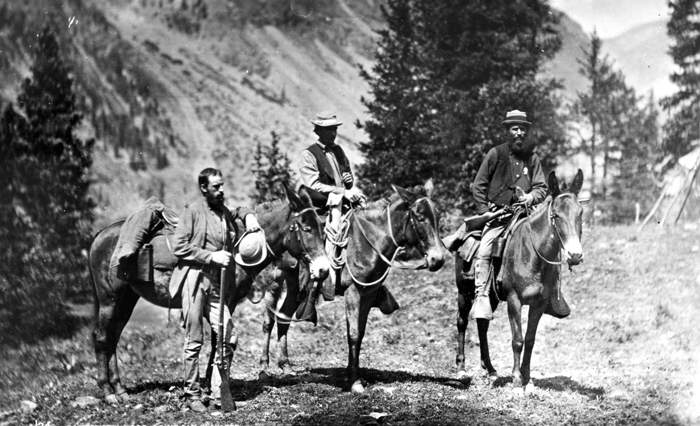
A.D. Wilson in 1874 (far right)
A.D. (Allen David) Wilson (1844-1920) enlisted with the Geological Survey of California in 1867.  In July 1868, he joined Clarence King for his Geological Exploration of the Fortieth Parallel and stayed with him through 1872. Wilson then joined Ferdinand Vandeveer Hayden and between 1873 and 1878, he triangulated across western Colorado, western Wyoming, and eastern Idaho.

In 1879, Hayden's Survey was merged with others to form the U.S. Geological Survey. Clarence King named Wilson the chief topographer of the USGS.

During the 1890s, Wilson relocated to Oakland, California where he and other civic leaders organized the Athenian Bank (later renamed the Security Bank and Trust of Oakland). In 1918, the bank was absorbed by the Bank of Italy and soon thereafter became the Bank of America. He died of influenza on February 21, 1920 in Oakland.


Newspaper ads showed "cures" for the flu from milk, herbs and chiropractic work


Friday, January 20, 2012

Clara Bedell a.k.a. “Diamond Carrie” – Wealthy 19th Century Madam (1854-1891)

Gravestone of Clara Bedell & family

PLOT 14B

Today, the building at 201–209 Post Street, a block from Union Square, is associated with Prada and San Francisco’s luxury shopping district. In the late nineteenth century, however, this was the realm of Clara Cecelia Bedell, better known as Carrie Maclay—and best known of all as “Diamond Carrie.”

Bedell was an Iowa native who came from a farming family. By the 1880s, she was operating an expensive “parlor house” at 205 Post Street. Unlike the cheaper establishments clustered along nearby Morton Street—later renamed Maiden Lane—parlor houses offered elaborate furnishings, fashionable surroundings and carefully dressed women to a prosperous clientele.

201-209 Post St. today (Cushman Wakefield)
Bedell’s establishment extended through the block to 108 Morton Street, with the two buildings connected by a covered passageway across their second floors. Census records examined by San Francisco historian Peter Field indicate that eleven young women were living or working there in 1880, most in their late teens or early twenties.

For nearly a decade, Bedell managed what one newspaper called a “gilded palace of sin.” The same account described her as a woman of “considerable executive ability”—a grudging Victorian acknowledgment that she had built and managed a highly profitable business. Her lavish display of jewelry, particularly diamonds, gave her the name by which San Francisco remembered her.

Her story should not be romanticized. The nineteenth-century sex trade could be coercive and dangerous, and the limited evidence tells us much more about the women who managed its most visible establishments than about those who worked inside them. Nevertheless, Bedell occupied an unusual position. At a time when most women had little independent economic power, she controlled a substantial enterprise, accumulated a fortune in her own name and decided for herself how that fortune would be distributed.

In September 1891, violence entered her house. Beauregard McMullin, the 28-year-old son of a prominent Fresno-area family, arrived after drinking heavily and confronted a woman named Mattie Raymond, with whom he had become infatuated. He threatened to shoot her, but Raymond escaped. McMullin then turned the gun on himself, dying in a room adjoining Bedell’s residence.

San Francisco around the time "Diamond Carrie" ran her business

Less than a month later, Diamond Carrie was dead.

According to the San Francisco Morning Call, Bedell had spent part of the day looking for another house because her Post Street lease would expire the following year. That evening, she drank champagne, returned to her apartments around three in the morning and apparently took opium to help herself sleep. Her housekeeper later found her unconscious beside a glass containing wine and opium. Several physicians attempted to revive her with a stomach pump and the customary antidotes, but she died early on October 16, 1891, at the age of 36.

Clara Bedell's death notice (SF Morning Call)

The coroner’s jury ruled the death an accidental opium poisoning. Later writers have wondered whether the overdose might have been deliberate, particularly given the recent suicide in her house and the fact that she had completed her will only four months earlier. The surviving evidence, however, does not establish suicide, and the contemporary legal finding was accidental death.Her handwritten will revealed the world she had built around herself. The initial probate filing valued her estate at approximately $25,000, consisting of jewelry, clothing, books, furniture and other personal possessions. She did not own the Post Street building; her wealth was primarily movable property and the accumulated proceeds of her business.


Bedell distributed jewelry and clothing among several female friends and relatives. Her “dear friend,” former Nevada judge Richard S. Mesick, received her library, two paintings, a silver tray and pitcher, and two silver goblets—one reportedly engraved with his initials and the other with hers.

She left $500 and a gold-and-jet chain to a Chinese man named Jim, and $250 each to two other Chinese men, described in the racial language of the newspaper as her “Chinese boys.” The bequests are notable because Chinese residents faced extraordinary discrimination in San Francisco, and because Bedell recognized them individually in a will otherwise dominated by family members and close associates.

Her mother received the remainder of the estate, which was ultimately to pass to Bedell’s two sisters. Fannie Howard, who had helped operate the house, was instructed to continue the business until the lease expired. Howard would receive one-half of its profits, with the other half going to Bedell’s mother, as well as a separate bequest of $1,000. Bedell also directed that her body be cremated—still an uncommon request in 1891.

What was $25,000 worth? A straightforward comparison of consumer purchasing power places it at approximately $950,000 today. But because Bedell’s estate represented accumulated personal wealth rather than a single consumer purchase, economic historians offer another useful comparison: relative to the wealth of the country, her fortune would represent approximately $9.4 million today. There is no single perfect conversion across 135 years, but either measure demonstrates that Diamond Carrie died a wealthy woman. 

Some later reports placed the estate closer to $50,000. Were that figure accurate, it would translate into approximately $1.9 million in modern purchasing power—or nearly $19 million when measured as relative wealth.


Her death did not end the drama.

Bedell’s father, Edmund D. Bedell, had been omitted from her will and was divorced from her mother. He challenged the administration of the estate, alleging that Clara had been addicted to opium, mentally unsound and improperly influenced by one of her sisters. Her parents and the public administrator became entangled in a prolonged contest over who had the legal right to manage the estate.

Judges criticized some of the appointments as irregular, and the dispute moved through the courts for more than a year. Her father eventually settled his claim for $2,250. The contents and business of the brothel were auctioned, reportedly to another local madam, Sadie Young. 

A later appraisal listed 23 separate pieces of diamond jewelry. There was also an extraordinary $10,000 life-insurance policy on Judge Mesick that he had assigned to Bedell in 1887. After her death, Mesick attempted to regain control of the policy, producing yet another lawsuit and ensuring that Diamond Carrie’s name continued appearing in San Francisco newspapers long after her cremation. 

Sources: The San Francisco Call Bulletin, FoundSF, Cushman Wakefield, Measuring Worth, San Francisco Examiner and San Francisco Chronicle 

Monday, January 16, 2012

John Muir Tour preview from Dr. Ron Bachman

JOHN MUIR

Dr. Ron Bachman discusses his upcoming tour about John Muir. The tour is free to public on Saturday, January 28th at 8 am. Located at Mountain View Cemetery, Oakland, 5000 Piedmont Avenue. He will be joined by docent Sarah Calhoun.